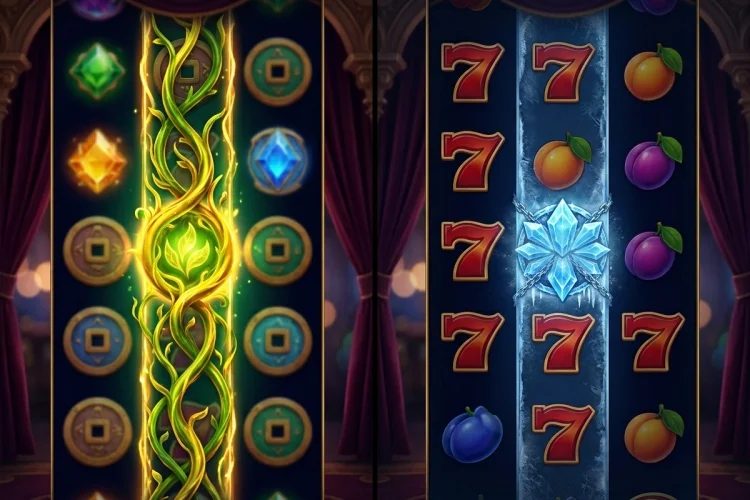

Red Tiger Slots Explained: Mechanics, Jackpots, and Themes

Red Tiger Slots Explained: Mechanics, Jackpots, and Themes

Red Tiger has released everything from simple fruit-style games to complicated grid slots, Megaways titles, jackpot products, and feature-driven adventures. That variety can make the portfolio look random at first, but several recurring design ideas tie the games together.

Across Red Tiger Slots, the studio frequently experiments with expanding reel areas, mystery symbols, persistent features, wild progression, and jackpot overlays.

Its proprietary mechanics also help distinguish the brand from other studios inside the Evolution group. Looking at those systems is a useful way to understand why some Red Tiger games feel very different even when they share similar themes.

Power Reels Expands the Traditional Slot Layout

Power Reels™ is one of Red Tiger’s proprietary mechanics.

Rather than staying with the traditional 5×3 format, Power Reels games can expand the reel area and create more positions for winning combinations.

Mystery Reels Power Reels combines the mechanic with one of the studio’s best-known features. The game runs on a 7×6 layout and pays in both directions, while its Mystery Symbol appears as a large 2×2 Super Symbol that can clone itself across the grid.

Evolution lists the title at 96.67% RTP with high volatility.

The mechanic demonstrates a common Red Tiger design philosophy: take a relatively simple feature and increase the scale around it.

Mystery Symbols Add a Second Reveal

Mystery mechanics appear repeatedly across the portfolio.

In the original Mystery Reels, the Mystery Symbol spreads across several reel locations and then reveals one paying symbol across all cloned positions.

Mystery Reels Deluxe updates the presentation but retains the basic idea of cloning and revealing symbols.

This mechanic adds suspense after the reels have technically stopped.

Instead of immediately knowing the result, players wait for the mystery positions to reveal what they have become.

It sounds like a small detail, but it changes the rhythm of the game considerably and has become one of the studio’s more recognisable feature styles.

Cluster Mechanics Move Away from Paylines

Red Tiger also experiments with grid-based games that replace standard paylines with connected winning symbols.

Thor’s Lightning uses a 7×7 grid where winning clusters help destroy eight locked positions in the middle of the board. Breaking through them can unlock one of two free-spin modes.

Evolution’s Red Tiger brand overview also identifies ClusterBuster™ as one of the studio’s proprietary mechanics.

Cluster gameplay can initially feel confussing for players accustomed to paylines because symbol position works differently.

Instead of following lines from left to right, you watch for groups of matching symbols and how those wins affect the rest of the grid.

Everyway Adds Another Route to Winning

Everyway™ is another proprietary Red Tiger mechanic listed by Evolution alongside Power Reels and ClusterBuster.

The idea fits into a broader industry trend toward replacing fixed paylines with more flexible win structures.

That makes the studio’s portfolio fairly diverse. Some titles still use classic paylines, while others use clusters, Megaways, or alternative ways-to-win systems.

This variety is useful because players do not need to like every Red Tiger game to find a format that suits them.

Someone who prefers conventional slots might gravitate toward 777 Super Strike, while grid fans may be more interested in Thor’s Lightning or similar cluster-driven titles.

Wild Features Can Drive Entire Bonus Structures

Wild symbols are another area where the studio regularly experiments.

Wolf Stacks Megaways uses stacked wilds that can remain locked during cascades. When a stack contributes to a win, the lowest available wild disappears while the others remain and drop downward during the next reaction.

777 Super Strike takes a more traditional route with regular wilds and expanding wilds. Its later bonus stages can even keep wild symbols locked during additional free spins.

Emperor of India goes further by introducing several upgraded wild stages, including multipliers and persistent behaviour as a progression meter develops.

These games show how one familiar slot symbol can support very diferent gameplay.

Red Tiger Jackpots Can Sit on Top of the Base Game

Red Tiger’s jackpot system is unusual because participating titles can be available with or without the network jackpot layer.

Official game factsheets explain that jackpot-enabled versions use a base-game RTP plus a jackpot contribution. Contribution levels can range from 1% to 6%, depending on the configuration.

Evolution also describes the Daily Drop Jackpots Network as a system distributing hourly and daily prizes across participating games.

This separation helps explain why two versions of what appears to be the same Red Tiger game can display different RTP information.

One may be the standard game, while another includes the jackpot contribution.

Jackpot Contribution Does Not Mean Every Spin Pays More

The jackpot component needs to be understood separately from normal slot results.

Red Tiger documentation for Emperor of India explains that a with-jackpot base configuration can be paired with a jackpot contribution to create the final overall RTP. The contribution itself is calculated separately from the normal base-game return.

That does not mean every ordinary spin suddenly produces higher payouts.

A portion of the mathematical return is connected to the jackpot system instead.

For players, the practical lesson is simple: compare the total RTP of the active version and read the jackpot rules rather than focusing only on one component.

It is an easy detail to overlook when comparing slots from multiple casinos.

Themes Range from Classic to Highly Cinematic

Red Tiger is difficult to define by theme alone.

Mystery Reels uses traditional fruit-machine imagery. Pirates’ Plenty moves into nautical adventure, while Thor’s Lightning uses Norse mythology. Jackpot Quest adopts a comic-book style, and 777 Super Strike goes back to recognisable classic casino symbols.

Newer games are becoming more cinematic.

Take the Money uses a bank-heist setup with a 20-spin cycle, Heist Score, and Cut percentage. The slot turns the theme into a mechanical system rather than simply placing bank robbers behind a normal reel game.

This is generally where Red Tiger’s stronger themes work best: the visual idea explains what the mechanic is doing.

Pirate Games Show How Red Tiger Builds Franchises

Pirates’ Plenty is a good example of how the studio develops game families.

The original Sunken Treasure version revolves around map collection and unlocking a sixth reel.

Pirates’ Plenty Megaways adds changing ways to win and can reach 200,704 Megaways after Lady Anne’s Wild Ways is unlocked.

The newer Treasures of the Sea edition changes direction again, using treasure chests, locked wild respins, multipliers, Treasure Spins, and a 20,000x guaranteed Kidd’s Treasure after opening all five chests.

This approach makes the franchise feel connected while avoiding a simple reskin.

Modern Releases Use More Persistent Progression

Some of Red Tiger’s latest games place more emphasis on what happens over a sequence of spins.

Take the Money structures the base experience around a fixed 20-spin bank-heist cycle. The score accumulates while the player’s Cut percentage determines how much of that score is eventually awarded.

Pirates’ Plenty: Treasures of the Sea uses locked wild positions and treasure chests that remain relevant throughout a bonus sequence.

This persistent style creates more visible progression than older slots where every spin essentially resets the board.

It also makes reading the rules more important because the final result may depend on several interacting stages.

RTP Options Can Vary Significantly

Red Tiger frequently supplies several mathematical versions.

Wolf Stacks Megaways, for example, has multiple non-jackpot and jackpot RTP configurations.

Take the Money is currently listed by Evolution with 96.11% and 93.08% RTP versions, while newer titles such as Digging for Wilds also display more than one percentage.

This makes checking the actual game information particularly important.

Do not assume a review quoting one percentage describes every casino implementation. The exact active configuration can be seperate from another version with identical artwork.

Which Red Tiger Style Is Best for You?

Players who like simple feature concepts may prefer Mystery Reels or 777 Super Strike.

Those interested in larger grids might look toward Thor’s Lightning or Power Reels titles. Megaways fans have options such as Pirates’ Plenty Megaways and Wolf Stacks Megaways.

Jackpot-focused players may prefer titles connected to Red Tiger’s network, while newer releases such as Take the Money offer more structured progression.

There is no universal “best” mechanic.

The better approach is to understand what happens after the reels stop, check volatility and RTP, and decide whether the game’s rhythm matches what you actually enjoy.

Red Tiger Slots combine proprietary mechanics, mystery features, jackpots, wild progression, and a broad range of themes.

Power Reels expands the grid, jackpot networks add another payout layer, and franchises such as Pirates’ Plenty show how the studio keeps evolving familiar ideas.

Check the active RTP, jackpot configuration, and feature rules before playing, then choose the design that feels most engaging rather than simply chasing a headline prize.


Free Spins with No Deposit: What to Check Before Claiming

Free Spins with No Deposit: What to Check Before Claiming

No-deposit free spins have an obvious attraction: you can receive promotional slot rounds without first making the deposit normally associated with a casino bonus. Still, two offers promising the same 50 spins can have completely different practical value.

One might provide straightforward winnings with simple conditions. Another may include low-value spins, a short expiry window, selected games, and restricted bonus winnings.

That is why evaluating Free Spins with No Deposit requires more than counting how many rounds appear in the headline. A few minutes spent reading the rules can reveal exactly what you are agreeing to.

No Deposit Is Not the Same as No Requirement

The phrase is easy to misunderstand.

A no-deposit bonus means a dedicated qualifying deposit is not necessary to receive the promotional spins. It does not promise that the casino will skip registration, verification, promotional eligibility, or other conditions.

BetMGM explains that no-deposit free spins can still require actions such as creating an account or completing another qualifying step.

The promotion might also be restricted to completely new customers.

Before registering, look for who qualifies, whether an opt-in or code is needed, and when the spins become active.

Those details tell you far more than the words “no deposit.”

Calculate the Nominal Spin Value First

Suppose Casino A advertises 200 spins while Casino B advertises 40.

Casino A appears five times better – until you discover that its spins are worth $0.05 each while Casino B’s are worth $0.50.

The nominal promotional wagering values would be $10 and $20 respectively.

That does not mean Casino B will produce more winnings. Slot outcomes remain random. But knowing the spin value allows you to compare the size of the promotional opportunity more sensibly.

Promotional spins usually come with a predetermined stake, meaning you cannot simply increase each free round to $1.

Always search the terms for phrases such as “free-spin value,” “stake per spin,” or “bonus play value.”

Check Which Slot the Spins Apply To

No-deposit spins are often issued for selected games rather than the entire casino library.

An operator may use the promotion to showcase a newly released slot or popular title. BetMGM’s current educational material describes free spins as bonus plays that can be connected to selected slot games.

That can be perfectly reasonable, but it affects the offer’s usefulness.

If you dislike the selected game’s mechanics or volatility, 100 spins on it may be less attractive than 25 spins on a title you genuinely enjoy.

Check whether one game or several games qualify and whether you have any choice about where the spins are used.

Find Out Where the Winnings Go

This is probably the most important question after spin value.

Imagine your free rounds produce $35 in winnings. Does $35 enter your withdrawable cash balance, or does it become restricted bonus credit?

Those are completely different outcomes.

The UK Gambling Commission says operators should make clear whether customers are playing with ordinary funds or promotional money subject to restrictions.

Check the bonus terms for phrases such as “cash balance,” “bonus balance,” “restricted funds,” or “winnings subject to wagering.”

Do this before playing, not after you happen to produce a large win.

Understand Wagering Before Doing the Math

A wagering multiplier can significantly change an offer.

For a simple hypothetical example, suppose your free spins create $25 in bonus winnings. A 10x wagering requirement applied to that $25 would mean $250 of qualifying wagering before the amount satisfies that condition.

At 5x, the required wagering would be $125.

But never assume the formula yourself. Promotions can define the wagering base differently, so read the precise calculation.

Great Britain’s updated social responsibility rules prohibit licensed operators from setting wagering requirements above 10x for promotional incentives. That rule has applied since January 19, 2026.

Different regulatory markets can have diferent requirements.

Look for Maximum Cashout Rules

No-deposit bonuses sometimes limit how much promotional value can ultimately become withdrawable.

For example, an offer might theoretically produce a large slot win but restrict the amount that can be converted from the no-deposit promotion.

The exact structure differs by operator and jurisdiction, so the cashout rule deserves its own check.

This is particularly important because maximum cashout and wagering requirements are seperate concepts.

Completing wagering does not necessarily remove an independently stated promotional cashout cap.

If the promotion contains such a limit, it should be clearly explained before you participate. A large displayed win can otherwise create unrealistic expectations about what the offer actually allows you to withdraw.

Watch for Maximum Bet Restrictions

Promotional play can also carry stake limits.

If bonus winnings need to be wagered, the terms may restrict the maximum amount allowed on each qualifying round.

The UK Gambling Commission’s consumer guidance specifically tells players to check restrictions on how bonus funds can be used, including limits on bet size.

This matters because increasing stakes dramatically after a lucky free-spin session may violate the promotional conditions.

The easiest solution is simple: read the maximum-stake rule before beginning play and keep your wagering within both the promotion conditions and your normal entertainment budget.

Expiry Can Reduce the Practical Value

A big promotional package is not useful if you have almost no time to use it.

A no-deposit offer might give you 24 hours, several days, or longer to use the spins. Resulting bonus funds can then have their own separate deadline.

Some spins may also arrive in batches.

Suppose 70 spins are advertised but only ten are released each day. Missing several daily windows could mean you never receive the full headline amount.

Check the schedule rather than assuming the entire package will sit in your account indefinately.

A short expiry is not a reason to rush. If an offer demands a pace you are uncomfortable with, skipping it is always an option.

Check the Withdrawal Process Before Playing

Even without an initial deposit, withdrawals can involve eligibility and verification checks.

The operator may need to verify identity, age, location, and payment information before processing funds. That is separate from whether the promotion itself required a deposit.

If you later add your own funds, regulated rules may also distinguish clearly between your deposit and promotional balance.

For Great Britain licensees, customer deposit balances must remain identifiable separately from bonus funds, and wagering requirements cannot be imposed on the customer’s own deposit before withdrawal.

That distinction is useful whenever promotional and ordinary funds exist in the same account.

Be Careful with Old Bonus Lists

No-deposit promotions can change quickly.

An article saying a casino offered 100 free spins six months ago does not prove the promotion remains active today. Eligibility, spin values, selected games, and conditions may all have changed.

Great Britain rules also limit when operators can alter promotions after customers have already opted in, helping protect participants from unfair mid-promotion changes.

For new customers, though, the sensible approach is still to open the operator’s current promotional terms before signing up.

Use review sites for discovery, not as a substitute for the actual rules.

Is a No-Deposit Bonus Automatically Better?

Not necessarily.

A no-deposit promotion reduces the upfront financial requirement, which can be appealing. But a deposit-linked promotion might offer different conditions, larger spin values, or simpler withdrawal treatment.

Neither format is universally better.

Compare what you actually receive and what you must do afterward.

If one offer gives 25 straightforward promotional spins while another advertises 300 with complicated wagering and a tight cashout cap, the smaller promotion may be easier to understand and use.

A good bonus should complement your entertainment budget rather than push you into extra spending or longer sessions.

Free Spins with No Deposit can let eligible players try selected slots without making a qualifying deposit, but the headline tells only part of the story.

Check spin value, eligible games, bonus-winnings treatment, wagering, cashout limits, maximum bets, and expiry before claiming.

Use the latest operator terms, confirm legal availability in your location, and treat the promotion as optional entertainment rather than guaranteed free money.

Can the Same Slot Have Different RTP Settings? How to Check

Can the Same Slot Have Different RTP Settings? How to Check

A slot review says a game has 96% RTP, but when you open the same title at a casino, its information screen says 92%. At first glance, that looks like an error – or something much more suspicious.

In reality, Can the Same Slot Have Different RTP Settings? Yes. Many developers create several certified mathematical versions of one slot, allowing different configurations to be distributed across operators and markets.

Knowing how to spot the active version is important because the difference may be invisible from the reels, artwork, bonus names, or even the advertised maximum win.

One Game Can Have Several Mathematical Versions

The easiest way to understand variable RTP is to separate the game’s presentation from its mathematics.

A familiar title can keep the same characters, symbols, layout, bonus animations, and basic rules while being supplied in several RTP configurations.

Quickspin’s Shields of Lambda is offered in 96%, 94%, 92%, and 87% versions. All four belong to the same 5×5 cluster-pay game with its Lambda Meter, Colossal Wild, tumbling wins, and Ferryman’s Free Spins.

The percentage is therefore part of the mathematical configuration, not necessarily something you can identify by looking at the artwork.

Wanted Dead or a Wild Has Four Published RTPs

Hacksaw Gaming provides an especially clear example.

Wanted Dead or a Wild has a maximum win of 12,500x and uses features including The Great Train Robbery, Duel at Dawn, and Dead Man’s Hand. Yet its official specifications list four different RTP settings: 96.38%, 94.55%, 92.33%, and 88.42%.

A casino running the 88.42% version can therefore present a game that looks very similar to one running at 96.38%.

The difference between those two numbers is almost eight percentage points, which is substantial from a long-term mathematical perspective.

This is why relying solely on the game’s name can be misleeding.

Why Developers Produce Lower and Higher RTP Models

Different markets have different commercial and regulatory environments.

Quickspin openly states that Reel Nightmare is available in 96%, 94%, 92%, and 87% RTP models to support broad market reach and different margins.

Play’n GO has also discussed certifying its slots across multiple target RTP levels for deployment in numerous jurisdictions.

The provider typically builds these mathematical models before distribution. Operators can then offer an appropriate approved configuration depending on the supplier setup and market.

That is very different from someone manually changing individual spins after seeing whether a particular player is winning.

How Can Different RTPs Be Created?

There is no single universal method.

A developer could change probabilities or payout contributions in different parts of the game while preserving the same general feature structure.

Imagine a fictional slot where the base game contributes 65 percentage points of theoretical RTP and the bonus contributes 31 points, creating 96% overall.

A lower version might keep much of the regular game similar but reduce the theoretical contribution of the bonus. Another design might distribute the reduction across multiple components.

The important point is that a two-percentage-point reduction does not necessarily mean every prize simply becomes 2% smaller.

The mathematics can be far more complicated.

Your Short Session Cannot Reveal the RTP Version

Suppose you play 100 spins and finish with a profit. That does not prove you found the highest-RTP version.

Likewise, losing quickly does not prove that the casino uses a lower configuration.

RTP represents a long-term mathematical expectation, while individual sessions contain significant random variation.

A player could hit a huge bonus on an 87% game and outperform somebody playing a 96% configuration during the same number of spins.

This is why trying to “feel” the RTP from recent results is not a reliable method. You need the published game information.

The Best Place to Check Is Inside the Slot

Push Gaming’s Jammin’ Jars provides a practical example of good disclosure.

Its official page lists 96.83% and 94.25% variants and says that RTP may vary per casino. Push Gaming also explains that the active percentage can be found in the game’s user panel and on its loading screen.

So imagine Casino A uses 96.83% while Casino B carries 94.25%.

A third-party review quoting 96.83% may not be incorrect—it may simply be describing a different configuration.

Always prioritize the percentage displayed by the version actually loaded in front of you.

Regulation Can Require RTP Information

In regulated markets, players may have specific rights to information about the games they are using.

Under Great Britain’s Remote Gambling and Software Technical Standards, relevant game rules must be easily available before play. The required information includes how winners and prizes are determined and either the house edge, RTP percentage, or relevant probability information.

The goal is to help customers make an informed decision before gambling.

This requirement makes checking the rules panel more than a technical exercise. It is where important mathematical information is supposed to be communicated.

Regulations differ internationally, however, so disclosure formats may not be identical everywhere.

Can the RTP Be Changed Mid-Session?

Variable RTP sometimes leads to the fear that a casino can simply lower someone’s personal percentage after a big win.

That is not how properly regulated random games are supposed to operate.

UK Gambling Commission standards state that random outcomes must meet fairness requirements and prohibit adaptive behaviour that changes outcome probabilities in response to previous play.

The rules, payouts, and outcome probabilities also cannot simply be altered while a game remains available without complying with specific change and disclosure procedures.

In other words, an approved 92% edition and a 96% edition can exist, but that is not the same thing as secretly switching one individual player between them after every few spins.

That distinction is extremly important.

Why a Few Percentage Points Matter Long Term

Consider two games with identical stakes and features but different theoretical returns.

If $20,000 is cumulatively wagered, a 96% game represents an expected theoretical return of $19,200. At 92%, the corresponding theoretical figure is $18,400.

The difference is $800 across that wagering volume.

Real-world outcomes will not neatly follow either figure because variance remains present, but the calculation illustrates why the higher RTP is mathematically preferable when everything else is genuinely equal.

The effect becomes more meaningful as cumulative wagering increases.

Higher RTP Does Not Mean Lower Volatility

Another mistake is assuming that a 96% version must feel calmer than a 92% one.

RTP and volatility are distinct measurements.

RTP tells you the theoretical proportion returned over very long-term play. Volatility describes the distribution of payouts—whether outcomes tend toward frequent smaller prizes or less frequent, potentially larger ones.

Reel Nightmare, for example, is explicitly described by Quickspin as highly volatile while also being available in four different RTP models.

You should therefore examine both numbers instead of treating one as a replacement for the other.

Make RTP Checking a Habit

Before playing any unfamiliar slot, spend a moment opening the game information.

Look for terms such as RTP, theoretical return, game rules, help, or paytable. If a provider’s website lists multiple variants, compare those numbers with what is displayed by the casino.

Also be careful with old reviews. Providers or casinos can offer versions different from the one originally tested by the writer.

A search snippet stating “this game has 96% RTP” is not enough when the developer officially supports several configurations.

Checking the active percentage gives you a far more acurate answer.

Can the Same Slot Have Different RTP Settings? Yes, and examples from Hacksaw Gaming, Quickspin, Push Gaming, and Play’n GO show that multiple configurations are a normal part of modern slot distribution.

The difference may be invisible during ordinary gameplay, so check the actual game’s information panel before playing. Compare RTP alongside volatility and features, and remember that theoretical return never guarantees a particular short-term result.

Best Free Slots with Wild Symbols: A Guide to Wild Features

Best Free Slots with Wild Symbols: A Guide to Wild Features

The word “wild” sounds simple until you start exploring modern online slots. In one game, it may only replace another symbol. In the next, it could expand over an entire reel, lock itself in place, carry a growing multiplier, or transform a huge section of the screen.

That variety is what makes the Best Free Slots with Wild Symbols interesting to explore in demo mode.

You can learn exactly how each mechanic works without risking money, while also comparing paylines, cluster systems, bonus rounds, volatility, and other features that shape the overall experience.

Start with the Basic Wild Symbol

The classic wild is essentially a substitute.

Imagine a payline showing two matching high-value symbols, followed by a wild. If the game’s rules allow it, that wild can substitute for the missing matching symbol and complete the combination.

However, there are usually exceptions. Wilds often cannot replace scatters, bonus symbols, jackpots, or other special icons.

This is why opening the paytable is important even when a feature looks familiar. Developers can use the same word while applying slightly different rules.

Expanding Wilds Can Cover an Entire Reel

Expanding wilds take ordinary substitution one step further.

Starburst is a well-known example. When its Starburst Wild appears on an eligible reel, it expands vertically to cover that reel and triggers a respin. Because the game pays across ten paylines in both directions, a fully wild reel can participate in several combinations simultaneously.

Evolution lists Starburst with an RTP of 96.09% and low-to-mid volatility. An official demo is also available on its game page where supported.

The mechanic is visually simple, making it a practical first demo for anyone who has never played a slot with special wild behaviour.

Sticky Wilds Stay Around for Longer

Sticky wilds are based on persistence rather than size.

NetEnt’s Stickers converts regular wilds into Sticky Wilds. When one lands, it remains fixed and triggers a Sticky Spin. New sticky symbols appearing during that sequence can award additional spins, with the locked wilds staying in position until the Sticky Spin session ends.

Quickspin’s Sticky Bandits uses a similar concept in a different way. Massive Wild symbols can help activate the free-spin bonus, and positions that are wild when the feature begins remain wild for the duration of the bonus.

Both games use persistence, but the actual implementation is quite diferent. That is exactly why testing features in demo mode can be useful.

Multiplier Wilds Can Increase a Winning Combination

Some wilds do more than substitute—they modify the value of the result.

Jammin’ Jars uses Jam Jar symbols that function as both wilds and scatters. Every jar also carries a multiplier, beginning at 1x, which applies to wins involving that symbol.

The game combines these wild multipliers with an 8×8 cluster-pay grid and cascading symbols.

That means one wild can play several roles at once: connecting a winning cluster, contributing a multiplier, and helping trigger the free-games feature.

Mechanics like this can look complicated when described in text, but a free session makes the interaction much easier to understand.

Massive Wilds Change More Than One Position

A normal wild occupies one symbol position. Massive wilds can occupy several.

Sticky Bandits: Wild Return features bandit characters that can appear as symbols as large as 3×3 positions. During its Lucky Shot Free Spins Bonus, bandit symbols can transform into Sticky Wilds, meaning an entire large symbol can turn into a wild area.

That changes how you read the grid.

Instead of watching individual positions, you need to think about how one large symbol can influence several reel locations at the same time.

Quickspin also includes a separate Quick Slot feature where a win can reach up to 500x the bet on a single Quick Slot spin.

Grid Slots Give Wilds a Different Job

Wilds behave differently when paylines disappear entirely.

Reactoonz from Play’n GO uses an unusual 7×7 cluster system. Five or more matching aliens need to connect to generate a qualifying cluster, while Flux Capacitors act as wild symbols. Winning clusters also charge Gargantoon, which can later enter the grid as a large wild feature.

Because there are no traditional paylines, wilds help build connected groups rather than simply filling a missing spot along a fixed line.

The official Reactoonz page includes a playable free demo, making it particularly usefull for seeing the difference firsthand.

Wild Symbols Do Not Automatically Mean Better Odds

A powerful-looking wild does not automatically make a slot more generous.

The feature is already part of the game’s mathematical model. Developers account for wild frequency, multipliers, bonus triggers, symbol values, and other mechanics when determining how payouts are distributed.

For example, Jammin’ Jars is classified as high volatility despite having cascading wins and multiplier wilds. Its official page also lists multiple RTP configurations, currently including 96.83% and 94.25%.

So a slot with spectacular wild animations may still produce long periods without a significant result.

How to Compare Wild Features in Free Mode

Instead of simply pressing spin, use demo mode to investigate specific mechanics.

Watch where wilds can land. See whether they replace every symbol or only regular ones. Check whether a sticky wild lasts one respin or an entire bonus round.

Also pay attention to supporting features. A multiplier wild becomes more interesting when it stays in place, while an expanding wild may become especially valuable in a game with many paylines.

Keeping the virtual bet consistent across different demos can also make balance fluctuations easier to compare.

The key is learning the rules, not trying to find a supposedly “hot” demo.

Free Wins Do Not Predict Real-Money Results

A very successful free session can easily create the wrong impression.

Suppose you trigger Sticky Wilds three times in twenty demo spins. That sequence does not mean the same feature will appear at a similar rate later. Random outcomes naturally create lucky and unlucky streaks.

Likewise, spending hundreds of demo spins without activating a feature does not mean it has become overdue.

Use free games to understand mechanics, interface design, and bet settings. Treat results themselves seperately from any future session.

Choosing the Right Wild Slot for Your Style

There is no universal best wild mechanic.

Starburst suits players who want a straightforward expanding feature. Stickers puts more emphasis on locked symbols, while Jammin’ Jars combines wilds with multipliers and cluster pays.

Reactoonz works well for anyone who prefers large grids, and Sticky Bandits adds a more feature-heavy free-spin structure.

Try them without financial pressure, then ask a simple question: did you actually enjoy the way the wild feature changed the game?

That answer matters more than choosing the slot with the flashiest animation.

The Best Free Slots with Wild Symbols range from simple expanding wild games to complex titles with sticky, massive, and multiplier variants. Free demos are a practical way to learn those differences without financial risk.

Explore the paytable, watch how each wild interacts with other features, and choose games based on mechanics you understand and enjoy rather than short-term demo results.

Best Online Slots with Cascading Reels: Features That Matter

Best Online Slots with Cascading Reels: Features That Matter

Cascading reels have changed what a single slot spin can look like. Instead of every result ending immediately, winning symbols may disappear, replacements fall into the empty spaces, and another combination can form without a second wager.

That is why finding the Best Online Slots with Cascading Reels is not simply about choosing the game with the flashiest animation. Some cascades increase multipliers, some work with cluster pays, and others feed bonus meters or free-spin features.

Understanding these differences makes it much easier to compare games and recognize what is actually happening behind all those falling symbols.

Cascading, Tumble, and Avalanche Features Explained

Slot developers often use different names for essentially similar mechanics.

A cascade normally removes winning symbols and replaces them with new ones. Pragmatic Play commonly describes this as a Tumble feature, while NetEnt famously uses the Avalanche name in Gonzo’s Quest.

The details can still differ considerably. Some games allow unlimited consecutive cascades until no further win occurs. Others add special conditions such as increasing multipliers or unlocking new features.

So when comparing slots, focus on the actual rules rather than the marketing name.

Gonzo’s Quest Shows Why Consecutive Multipliers Matter

One reason Gonzo’s Quest became closely associated with cascading gameplay is its escalating multiplier.

After a winning combination, the Avalanche mechanic removes those symbols and replaces them. If another win follows, another Avalanche occurs and the multiplier increases. The progression can eventually reach 5x during the base-game sequence.

This provides a clear incentive for longer chains. The first payout may be modest, but continuing Avalanches can make later wins in the same sequence more valuable.

It is also a good reminder that the number of cascades matters only in combination with the game’s paytable. Lots of reactions do not automatically mean a large final payout.

Sweet Bonanza Uses Pays Anywhere Instead of Paylines

Sweet Bonanza demonstrates how cascading mechanics can work without conventional paylines.

Players need at least eight matching symbols anywhere on the grid to create a win. Those symbols are removed, new ones tumble downward, and the process repeats whenever another qualifying combination forms.

During the free-spins feature, candy-bomb multipliers can appear with values between 2x and 100x. Multiple multiplier values appearing during a successful tumble sequence are combined before being applied to the tumble win.

This structure makes symbol quantity more important than position. You do not need to follow a traditional left-to-right payline.

Cluster Pays Create a Different Type of Cascade

Cluster slots change the experience again because matching symbols normally need to touch one another rather than land on predetermined lines.

Reactoonz uses a 7×7 grid where clusters of five or more identical characters can produce wins. Winning creatures disappear and new symbols fall into their positions, potentially generating additional clusters.

Jammin’ Jars follows a related idea on an 8×8 grid, requiring at least five matching fruits for a paying cluster. Its cascading structure is combined with Wild Jam Jars carrying multipliers.

For players used to classic paylines, this system can initially seem confussing. After a few rounds, however, it becomes relatively intuitive because the focus shifts toward groups of matching symbols.

Megaways and Cascades Can Work Together

Cascading reels are also frequently paired with dynamic reel systems.

Big Time Gaming’s Bonanza can offer up to 117,649 ways to win through its Megaways structure. The game’s Duel Reaction mechanic then allows winning symbols to disappear and replacements to cascade into the layout.

The main difference is that the number of symbols visible on each reel can vary. This means both the available win ways and the symbol arrangement can change frequently.

Bonanza is therefore considerably more dynamic than a fixed-grid cascade game, even though both rely on the same basic idea of removing winning symbols and replacing them.

More Cascades Do Not Mean Better RTP

It is easy to assume that receiving several possible wins from one stake must improve a player’s theoretical return. That is not necessarily the case.

Cascade frequency, symbol values, multipliers, bonus probability, and other mechanics are all part of the game’s mathematical design. A slot can produce frequent cascades while keeping individual payouts relatively small.

RTP should therefore be checked seperately. Bonanza lists a 96% RTP, while Gonzo’s Quest lists 95.97%. Jammin’ Jars currently publishes several possible RTP configurations, including 96.83% and 94.25%.

These percentages describe theoretical long-term return and should never be interpreted as a guarantee for a short session.

Volatility Changes the Experience

Two cascading slots can feel completely different even if their mechanics look similar.

High-volatility games typically produce wider swings. There may be more periods with limited returns, while some feature combinations carry larger potential payouts. Lower or medium-volatility games tend to distribute results differently.

Push Gaming classifies Jammin’ Jars as high volatility, for example. Gonzo’s Quest is listed as mid volatility on Evolution’s game page.

For practical comparision, volatility may matter as much as the cascade mechanic itself.

Check What Happens During Free Spins

Many cascading games become significantly more complicated after their bonus feature begins.

Sweet Bonanza introduces its multiplier bombs during free spins, while Bonanza uses free spins alongside its Megaways and cascading structure. Jammin’ Jars adds multiplier wilds that interact with cluster wins.

That means a review based only on base-game cascades may miss the most important part of a slot.

Before playing, check the help screen and learn what actually changes during the bonus. Pay particular attention to multiplier progression, retriggers, persistent symbols, and whether any features reset after each tumble.

What Makes a Good Cascading Slot?

There is no single cascade system that works best for everyone.

Players who prefer simple mechanics may enjoy the straightforward Avalanche format of Gonzo’s Quest. Those who like large grids might prefer Reactoonz or Jammin’ Jars, while players interested in dynamic win ways may find Megaways-style games more engaging.

The strongest choice is usually one where you understand the rules, volatility, RTP, and bonus structure before wagering. A complicated feature is not automatically better simply becuase more things are happening on the screen.

The Best Online Slots with Cascading Reels combine chain reactions with mechanics that give those cascades a clear purpose, whether through multipliers, clusters, free spins, or changing win ways.

Look beyond the falling-symbol animation and compare RTP, volatility, payout systems, and bonus rules. Trying a demo first can also help you understand the mechanics before deciding whether the gameplay style suits you.

Expanding Wilds vs Sticky Wilds: How Each Feature Changes Slots

Expanding Wilds vs Sticky Wilds: How Each Feature Changes Slots

A Wild symbol normally substitutes for other symbols to help complete qualifying combinations. Modern slots take that basic idea much further. A Wild might cover an entire reel, remain locked for several spins, carry a multiplier, or even do all three.

That is why Expanding Wilds vs Sticky Wilds is more than a terminology question. The two mechanics change reel behavior in different ways.

Expansion increases the Wild’s physical reach, while stickiness lets it remain active over several outcomes. Understanding that difference becomes particularly useful when both mechanics appear inside Free Spins or respin sequences.

Expanding Wilds Change the Shape of the Reel

An Expanding Wild starts by altering the visible grid.

In BGaming’s Fruit Million Respin, Wild symbols landing on reels two through four expand across the entire reel. They also trigger a respin and can carry random multipliers of 1x, 2x, 3x, or 5x.

This demonstrates the immediate nature of expansion.

One Wild does not simply substitute from its original cell. It transforms an entire reel into a Wild reel.

Another example is Eye of Atum from Play’n GO. The Atum Wild can appear on reels two, three, or four and expand to cover the full reel.

In both cases, expansion increases coverage rather than duration.

Sticky Wilds Change How Long a Symbol Matters

Sticky Wilds work in the opposite dimension.

Instead of becoming larger, the Wild remains anchored to a specific position.

NetEnt’s Blood and Shadow uses Sticky Wilds during Candle and Cursed Spins. Wilds settle toward the bottom of the reels and remain sticky until they participate in a winning combination or another terminating condition occurs.

That creates a different style of anticipation.

An Expanding Wild usually has an immediate impact when it grows.

A Sticky Wild creates future potential because each subsequent spin happens around a Wild that is already present.

The longer it stays, the more rounds it can potentially influence.

A Simple Example Shows the Difference

Imagine a five-reel, three-row slot.

A Wild lands in the middle of reel three.

With an Expanding Wild, that symbol could stretch vertically and occupy the top, middle, and bottom positions of reel three.

With a Sticky Wild, it might remain only in the middle position but stay there for the next five bonus spins.

Now imagine both mechanics working together.

The Wild expands to fill the entire third reel and then stays there for every remaining Free Spin.

That is effectively a Sticky Expanding Wild – a combination increasingly used by modern developers.

Pragmatic Play’s recent Eastern Fury provides this type of hybrid behavior. Expanding Wilds can cover entire reels and, during the bonus, remain sticky with their associated multipliers.

Respins Are a Natural Partner for Expanding Wilds

Expansion is frequently connected to respins because the full Wild reel creates a useful starting point for another outcome.

Fruit Million Respin is a clear example. Every qualifying Wild on the middle reels expands, triggers one respin, and introduces a multiplier. Consecutive Wild appearances can lead to several respins.

Starburst follows a simpler version of the same idea: its Wild expands over the entire reel and awards a respin.

This pairing makes sense mechanically.

The Wild expands first, then the game offers another opportunity to form combinations around the newly Wild-covered reel.

Whether the expanding reel remains available during subsequent events depends on the specific game’s rules.

Free Spins Are a Natural Partner for Sticky Wilds

Sticky Wilds become particularly powerful as a gameplay concept when several rounds are already guaranteed.

Suppose Free Spins begins with 10 rounds. Every Sticky Wild added to the grid can potentially remain involved through the rest of those spins.

This is why developers frequently reserve stickiness for bonus modes.

Pragmatic Play’s The Dog House: Royal Hunt keeps its qualifying Wilds locked during Free Spins and retains their multipliers for the feature.

NetEnt’s Stickers takes a different route. Regular Wild symbols can transform into Sticky Wilds and activate Sticky Spins.

The exact implementation varies, but persistence remains the core idea.

Expanding Wilds Can Have Conditions

A Wild does not always expand simply because it appears.

Totally Hot from BGaming places its Wild only on the third reel. The symbol expands across that entire reel when it forms part of a qualifying winning combination.

This differs from a game where expansion occurs immediately on landing.

Conditional expansion can create a more restrained mechanic because the Wild needs another event before reaching its full size.

Other games may limit expanding Wilds to specific reels, Free Spins, respins, or bonus modes.

That is why the feature name alone never explains everything.

Always check where, when, and under what condition the Wild expands.

Sticky Wilds Can Have Exit Conditions Too

“Sticky” does not always mean “stays until the entire bonus ends.”

Some Sticky Wilds remain for a fixed number of rounds.

Others disappear after participating in a win.

Blood and Shadow is a useful example because its Wilds remain sticky during special spins but can be removed after becoming part of a winning combination.

Other games keep them until the Free Spins sequence finishes.

This distinction affects how the feature progresses.

A permanent-for-the-feature Wild can gradually make the grid more populated. A conditional Sticky Wild creates more turnover because symbols can enter and leave throughout the sequence.

Both are legitimately described as sticky mechanics.

Expanding Wilds Can Also Become Sticky

Hybrid designs make the comparison more interesting.

BGaming’s Clash of Gods Power Duel offers two Free Spins paths. Its Anubis option uses Expanding Wilds that can stick until the end of the bonus, while the Hades route guarantees at least one Expanding Wild on every spin.

Pragmatic Play’s Eastern Fury similarly uses expanded Wilds with multipliers that remain sticky during its bonus game.

These games show that expansion and stickiness are not mutually exclusive categories.

Think of them as two independent properties:

Expansion = how much space a Wild covers.

Stickiness = how long that Wild remains.

A developer can activate either property – or both.

Multipliers Behave Differently With Each Mechanic

Wild multipliers introduce another variable.

An Expanding Wild multiplier can affect combinations crossing the enlarged Wild reel. Fruit Million Respin assigns expanding Wilds random multipliers, which are combined during its respin sequence.

Sticky Wild multipliers can remain available across several spins.

The Dog House Megaways attaches 2x or 3x values to its Wild symbols. In the Sticky Wilds feature, retained Wilds can continue carrying those multipliers while the feature progresses.

This persistence is one reason Sticky Wild multiplier features can feel increasingly powerful if multiple Wilds accumulate.

But the surrounding symbols still have to create qualifying results.

A large collection of Sticky Wilds does not guarantee a specific payout.

Which Feature Creates More Winning Possibilities?

There is no universal answer.

An Expanding Wild covering a complete reel can influence many paylines or ways to win immediately.

A Sticky Wild might cover less space but remain relevant through many more rounds.

The overall effect depends on the grid, paylines, symbol probabilities, multipliers, and bonus rules.

A game with one full-reel Expanding Wild may have a completely diferent mathematical profile from another game containing several small Sticky Wilds.

For this reason, feature names should not be used to estimate RTP or volatility.

Look at the actual game information instead.

The mechanics explain how the slot behaves, while RTP and volatility describe other parts of its mathematical design.

Which Wild Type Is Easier for Beginners?

A simple Expanding Wild is probably one of the easiest enhanced Wild mechanics to recognize.

The symbol lands and becomes larger.

Sticky Wilds are also straightforward once you understand that they remain fixed, but more elaborate versions may interact with multipliers, collections, retriggers, and other bonuses.

For beginners, official demo play can help.

Watch whether a Wild expands immediately or only after creating a win. Then check whether it disappears after the result or remains for another spin.

Those two observations usually identify the mechanic without needing complicated terminology.

Expanding Wilds vs Sticky Wilds compares two separate characteristics of enhanced Wild symbols. Expanding Wilds increase coverage across the grid, while Sticky Wilds remain active through later spins or bonus rounds.

Modern titles can combine both features with respins and multipliers. Check the paytable and demo first so you know exactly when the Wild grows, when it sticks, and when it disappears.

How to Choose a Reliable Slot Game Provider Before You Play

How to Choose a Reliable Slot Game Provider Before You Play

Choosing a slot based entirely on theme is easy. A colorful game with polished animation can look professional even when you know almost nothing about the studio that created it.

That is why understanding How to Choose a Reliable Slot Game Provider starts behind the reels. Reliable suppliers should be able to demonstrate regulatory approval, technical testing, transparent mathematics, secure software practices, and authentic distribution.

These checks cannot guarantee that you will win – no legitimate provider can promise that – but they can help you distinguish properly tested gambling software from questionable copies or poorly documented products.

Start With the Provider’s Real Corporate Identity

Before studying any slot, identify who actually built it.

A legitimate provider should normally have a corporate website with company information, contact details, regulatory disclosures, and identifiable legal entities.

This sounds basic, but copied casino games exist.

Play’n GO explicitly warns that unauthorized third parties have distributed imitations of its games that may appear legitimate on the surface. The company notes that such copies may lack proper certification and fairness verification.

This is why a recognizable game name is not enough.

If you are uncertain, check whether the title appears in the provider’s official catalog and whether the casino identifies the correct studio.

Authenticity should come before artwork, jackpots, or maximum-win claims.

Verify Licences Through the Regulator

A licence number should be verifiable.

Do not treat a small regulator logo on a provider website as sufficient evidence by itself. Where the regulator offers a public register or authorization database, use it.

The Malta Gaming Authority explains that companies supplying and managing critical gaming software can require a B2B Critical Gaming Supply licence.

For example, BGaming identifies Stable Games Ltd as its Malta-licensed entity under a B2B Critical Gaming Supply licence.

A legitimate licence does not mean every slot is ideal for you.

It does mean the provider operates within an identifiable regulatory framework.

Also remember that regulatory approval can be market-specific. A studio authorised in one jurisdiction is not automatically approved everywhere.

Independent RNG Certification Is a Strong Signal

Randomness is central to conventional online slots.

GLI says an RNG must be adequately tested to ensure unpredictability and to check for bias toward particular game outcomes. Its certification process can include specific statistical tests and technical analysis of RNG implementations.

The UK Gambling Commission requires RNG testing for relevant products to include documentation review, source-code verification, research into known weaknesses, and statistical testing of raw output.

That is a much stronger basis for assessing fairness than user comments saying a slot “pays well.”

Random results naturally produce winning and losing streaks.

A reliable provider should not need to support claims of fairness with anecdotal payouts.

Look for actual certification and regulatory testing instead.

RTP Should Be Published and Understandable

RTP is another useful transparency check.

GLI defines percentage RTP as the expected proportion of wagers returned through prizes over the long term. Its mathematical evaluations can measure RTP contributions from the base game, feature rounds, and jackpots while also assessing volatility.

A well-documented slot should explain its RTP somewhere in the rules or information screen.

The number should not be interpreted as a personal refund percentage.

A theoretical 96% RTP does not mean depositing $100 guarantees $96 back. Short sessions can vary dramatically because of randomness and volatility.

Still, publishing the figure gives players useful information about the mathematical model.

If basic payout information is completely absent, that lack of transparancy deserves attention.

Check Whether Game Rules Match What Happens on Screen

Reliable software should behave according to its published rules.

The UK Gambling Commission’s testing process includes verification of game design, mathematics, artwork, rules, theoretical RTP, and software implementation. Testing can use simulation, emulation, and manual gameplay.

This matters because modern slots contain increasingly complicated mechanics.

Wilds may multiply prizes, Scatters may trigger different numbers of free spins, grids may expand, and special features may contain entirely different mathematical rules.

A provider should explain these mechanics clearly enough that a player can understand why a result occurred.

The more complicated the slot, the more valuable clear rules become.

Flashy animation should never be a substitute for understandable game logic.

Security Certification Adds Another Layer

Fair RNG output is only one part of reliable gaming software.

Providers also operate servers, databases, development systems, and distribution infrastructure that require security controls.

The UK Gambling Commission’s remote technical framework includes security requirements based on information-security standards and independent audit processes.

BGaming, for example, states that it holds ISO/IEC 27001 certification and uses external laboratories including iTechLabs and BMM Testlabs for RNG evaluation.

This does not mean ISO certification predicts slot outcomes.

Its relevance is operational security and structured information management.

A provider showing both gaming-specific certification and broader security controls gives you more independant evidence to examine.

Do Not Judge Reliability From Maximum Wins

Marketing often emphasizes maximum multipliers such as 5,000x, 20,000x, or even much larger amounts.

Those figures describe upper limits or theoretical possibilities, not how often ordinary players reach them.

A provider with transparent 5,000x games is not automatically less reliable than one advertising 100,000x prizes.

Reliability is about whether the mathematics and advertised rules are implemented correctly.

Maximum win is a game-design characteristic.

Similarly, frequent social-media screenshots of large prizes do not prove that the game is fair, and a player experiencing a losing session does not prove it is unfair.

Focus on verifiable technical evidence rather than individual outcomes.

Look for Consistent Quality Across Several Games

A strong provider should usually show consistency across its catalog.

Try several official demos and compare load speed, mobile responsiveness, clarity of menus, paytable quality, audio controls, and how clearly bonus mechanics are explained.

One polished game could be an exception.

A catalog that repeatedly shows functional interfaces and understandable documentation gives a better impression of development standards.

The UK Gambling Commission also requires relevant testing when games are introduced through new client channels and expects commonly used devices or browsers to be considered.

Mobile performance therefore is not merely cosmetic.

For many users, the phone interface is the primary way they interact with the software.

Be Careful With Provider Claims About Fairness

Providers naturally market themselves positively.

BGaming, for example, publishes information about its licences, test-lab evaluations, security certification, and regulated-market approvals.

Those specific claims are more useful because they can potentially be checked against regulators or independent testing organizations.

Generic language such as “the fairest slots online” is less informative.

Ask what supports the claim.

Is there an identifiable regulator? A recognised testing laboratory? A certificate? A software licence? Published technical information?

Strong evidence should be more specific than advertising language.

This seperates measurable compliance signals from promotional copy.

Remember That the Casino Still Matters

Even excellent software can be offered through an operator you should not trust.

A provider normally controls the game. The casino controls your customer account and typically handles deposits, withdrawals, identity verification, promotions, and support.

The UK Gambling Commission makes this distinction explicit: a gambling-software licence authorizes software activities but does not by itself authorize the company to provide gambling facilities to consumers.

So provider research is only half the job.

Verify the operator’s licence and withdrawal rules separately.

A respected provider logo should never be treated as a shortcut for evaluating the entire casino website.

Learning How to Choose a Reliable Slot Game Provider means checking evidence rather than relying on branding. Look for verifiable licences, independent RNG testing, transparent RTP information, security controls, authentic games, and consistent technical quality.

Then evaluate the casino operator separately. Use official provider demos and regulatory databases whenever possible, and treat huge win claims as game specifications rather than proof of reliability.

Mistakes to Avoid When Claiming a Slot Bonus: Read the Fine Print

Mistakes to Avoid When Claiming a Slot Bonus: Read the Fine Print

Claiming a slot bonus takes only a few clicks. Understanding what happens after those clicks can require much more attention.

Promotional balances may come with wagering requirements, eligible-game rules, stake limits, and deadlines that are easy to overlook.

The Mistakes to Avoid When Claiming a Slot Bonus therefore go beyond forgetting to enter a promo code. Many problems appear after the offer has already been activated.

Knowing which balance is being used, how wagering is calculated, and what happens when you request a withdrawal can make bonus terms considerably easier to manage.

Mistake 1: Starting to Play Before Checking Which Balance Is Active

The first spin after claiming a bonus can matter more than you think.

Some account systems maintain separate deposit and promotional balances. UK Gambling Commission rules require deposit and bonus balances to be displayed separately and clearly for licensed operators in Great Britain.

The regulator also says customers should be informed when they are playing with restricted funds and reminded about applicable wagering or promotional restrictions.

That information helps you understand what happens to subsequent winnings.

Before spinning, check whether the stake will come from cash, bonus funds, or another balance arrangement described in the terms.

Do not assume the system will always use the balance you expect.

Mistake 2: Looking Only at the Bonus Percentage

“100% up to $500” sounds more impressive than “50% up to $100.”

But promotional value cannot be measured from the percentage alone.

Imagine the larger bonus requires a much bigger deposit and comes with more restrictive game conditions. The smaller offer could potentially be easier to understand and fit more comfortably inside a pre-existing budget.

The CMA emphasizes that operators should provide the information customers need to judge whether a promotion is suitable for them rather than hiding important conditions.

ASA guidance similarly requires significant conditions such as eligibility, wagering requirements, and time limits to be shown clearly.

Treat the headline as advertising – not as the complete value calculation.

Mistake 3: Confusing Wagering Requirements With Guaranteed Spending

Suppose you receive $30 of promotional credit with a 10x requirement.

That means $300 of qualifying wagers must be recorded for the requirement to be completed.

It does not mean the process costs exactly $300.

Your balance changes after every random outcome. It could decline before the wagering is finished, or eligible wins could temporarily increase it.

Since January 19, 2026, Great Britain-licensed operators cannot apply wagering requirements above 10 times the bonus funds covered by the rule.

That current UK cap is jurisdiction-specific and should not be assumed elsewhere.

The broader mistake is viewing a wagering requirement as a promise that the bonus can be converted simply by placing a fixed number of spins.

There is still gambling risk throughout the process.

Mistake 4: Ignoring Which Games Actually Count

A bonus may be advertised around slots, but that does not necessarily mean every available slot contributes identically.

The Gambling Commission’s glossary of significant promotional conditions specifically notes that operators may have restricted games or different wagering-contribution rates between products.

This makes eligibilty worth checking before choosing a title.

Imagine Game A contributes 100% toward a hypothetical requirement while Game B contributes 25%. Four dollars wagered on Game B would contribute only one dollar under that example.

A player ignoring this distinction may believe the wagering requirement is nearly complete when much more remains.

Look for the eligible-game list or contribution table before beginning.

Mistake 5: Breaking the Maximum-Stake Rule by Accident

Bonus stake restrictions are easy to miss when the slot itself offers several denomination options.

UK consumer guidance specifically mentions maximum stake restrictions as conditions that should be made clear where bonus money is involved.

For example, a promotional rule could hypothetically limit stakes to $5 while the slot interface allows $10, $20, or more.

One quick change in denomination could therefore create a problem.

Always check the current stake after changing games or returning to a previous session.

The UK Gambling Commission’s transparency guidance also says simply burying relevant restrictions inside lengthy website terms is not sufficient; players using restricted funds should be informed about them.

Still, reading the rule yourself is the safest habit.

Mistake 6: Racing Against the Expiry Clock

A bonus with a deadline can create unnecessary urgency.

You might see that only six hours remain and decide to increase your stake or play for much longer than planned in an attempt to complete the requirement.

That can turn a promotional offer into a reason for unplanned gambling.

Time limits are considered significant conditions in promotional advertising guidance.

A deadline should therefore be treated as information, not as a challenge that must be beaten.

If completing the wagering naturally fits inside your existing time and budget limits, fine. If it does not, allowing the remaining bonus to expire may be the more sensible option.

Never raise a spending limit simply to rescue “free” promotional credit.

Mistake 7: Assuming a Withdrawal Request Must Wait for the Bonus

One of the most damaging misunderstandings is believing that claiming a bonus automatically locks all money inside the account.

For Great Britain-licensed operators, players must be able to withdraw their deposit balance, including qualifying winnings from their own funds, without first satisfying promotional wagering requirements.

CMA guidance also says customers should be allowed to exit a promotion at any time with their remaining deposit and relevant deposit-derived winnings.

What may happen to unused bonus money when you leave the promotion is a seperate question governed by the disclosed terms.

This is why distinguishing bonus funds from cash is so important.

Check the consequence of cancelling the bonus before requesting a withdrawal, but do not automatically assume your own unrestricted funds must remain locked.

Mistake 8: Not Understanding What Happens to Bonus Winnings

Winning while using promotional funds does not always mean those winnings become immediately withdrawable cash.

The UK Gambling Commission defines a restricted bonus balance as potentially including winnings generated from bonus funds while wagering requirements remain incomplete.

In practice, an account might therefore show a sizeable promotional balance while the cash available for withdrawal remains much smaller.

Check how the operator handles conversion after the requirement is completed.

Also look for any disclosed maximum conversion or other bonus-specific limits where permitted in the relevant jurisdiction.

The key mistake is mentally spending bonus winnings before checking their status.

A number displayed on the screen and money currently available for withdrawal are not always the same thing.

Mistake 9: Assuming “Free” Means No Conditions

Words such as “free spins” or “free bonus” can sound like there is nothing required from the player.

That is not always the case.

ASA guidance says gambling promotions should not be described as “free” when customers must risk their own money to qualify in a way that makes the description misleading. It also requires significant conditions to be presented clearly.

Free spins might be genuinely awarded without payment, or they might require a deposit or another qualifying action depending on the offer.

Read what “free” actually refers to.

Does it mean no purchase required? Does it mean bonus spins after a deposit? Are winnings restricted afterward?

Those are different offers despite similar marketing language.

Mistake 10: Chasing the Bonus Because You Have Already Started

This is less about fine print and more about decision-making.

After completing 80% of a wagering requirement, it can feel wasteful to stop. That feeling may encourage someone to deposit more money or play beyond their planned limit.

But promotional progress has no guaranteed cash value.

The remaining balance is still exposed to random outcomes, and being close to the end of a wagering target does not guarantee that money will survive until completion.

A bonus should never determine how much you are willing to lose.

Decide your gambling budget before accepting the offer and keep the same limit afterward. If completing the promotion requires exceeding that amount, stop rather than treating previous wagering as something that must be recovered.

The most important Mistakes to Avoid When Claiming a Slot Bonus happen when players focus on the headline and ignore what occurs after activation. Wagering, eligible games, max bets, expiry, and balance status all matter.

Check the complete terms first, monitor which funds you are using, and never increase your spending simply to finish a promotional requirement.

Does a Higher RTP Mean a Slot Is Better? RTP vs Real Gameplay

Does a Higher RTP Mean a Slot Is Better? RTP vs Real Gameplay

RTP is one of the first statistics people notice when comparing online slots. If one game lists 96.5% and another shows 94%, choosing the larger number can seem like an obvious decision.

So Does a Higher RTP Mean a Slot Is Better? From a purely long-term mathematical perspective, a higher return percentage means a smaller theoretical casino advantage. But real slot gameplay involves more than expected return.

Volatility, prize distribution, bonus features, maximum wins, and even different RTP configurations can make two games with similar percentages behave very differently.

RTP Is a Long-Term Mathematical Expectation

Return to Player is not a prediction for an individual session.

GLI defines percentage RTP as the expected percentage of wagers returned by a specific game over the long run. Its game-mathematics testing can evaluate or simulate possible combinations to calculate the theoretical return.

This is fundamentally different from saying, “You will receive this percentage back.”

Suppose a game has a 96% RTP.

Across a huge mathematical sample, approximately 96% of wagered value is designed to return as prizes. Individual sessions can finish far above or below that percentage.

That short-term uncertainty is normal.

Why a One-Percent RTP Difference Still Matters

Although RTP is not a short-term guarantee, differences matter mathematically over enough wagering.

Imagine one theoretical slot has 96% RTP and another has 95%.

The corresponding theoretical house edges are 4% and 5%.

Across $100 of turnover, that one-point difference represents only $1 in theoretical expected value. Across $100,000 of otherwise identical turnover, the theoretical difference becomes $1,000.

That does not mean anyone should play longer to “reach” the expected value.

More wagering means more money exposed to the house edge.

The example simply illustrates why RTP matters mathematically even though it cannot predict an individual’s results.

Volatility Explains Why Higher RTP May Feel Worse

A slot with higher RTP can still feel much harsher during a limited session.

Evolution lists Dead or Alive 2 at 96.80% RTP and High Volatility. The game also offers three Free Spins bonus modes and potential wins reaching 100,000x the original stake.

Starburst, by comparison, has 96.09% RTP but Low/Mid volatility.

Dead or Alive 2 therefore has the higher theoretical return.

Yet someone experiencing a short sequence of spins could see much wider swings because the game’s prize distribution is more volatile.

This is why a higher RTP should never be interpreted as “more likely to give me a good session.”

RTP and Volatility Should Be Read Seperately

RTP answers a value question.

Volatility answers a distribution question.

The UK Gambling Commission describes theoretical RTP as the designed return percentage of the game. It describes highly volatile games as potentially containing very large but rare prizes, while lower-volatility titles tend to contain smaller and more frequent prizes.

These measures complement each other.

A theoretical 96.5% RTP does not tell you whether most of that return comes through regular small prizes, occasional bonus rounds, or extremely rare large results.

Volatility supplies part of that missing context.

Hit frequency, bonus frequency, and maximum prize provide additional information where they are disclosed.

Actual RTP Needs a Large Sample

The UK Gambling Commission provides a useful illustration of why short sessions cannot be judged against advertised RTP.

Its monitoring guidance uses an example game designed around 91.68% RTP. After £1.2 million in turnover and £1.085 million in prizes, the measured actual RTP was 90.42%.

That lower result did not automatically mean the game was faulty.

The regulator explains that volatility determines the acceptable statistical tolerance, and the range becomes narrower as more games are measured.

In its example, even hundreds of thousands of rounds can produce measurable variation around the theoretical figure.

A personal session involving a few dozen or hundred spins is tiny by comparision.

The Same Game Can Have Different RTP Versions

Another complication is that RTP is not always fixed to one percentage for every installation of a title.

Evolution lists NetEnt’s Superstars with RTP configurations of 96.08%, 94.06%, and 92.01%.

Starburst XXXtreme is also listed with two return figures, 96.26% and 96.45%, depending on the configuration or feature setup.

This matters when reading slot reviews.

A website might describe one RTP configuration while the casino you visit offers another.

The most pratical solution is to check the game’s current information or help screen before playing.

That is more reliable than assuming every version of a named slot uses the same return setting.

Features Can Change How You Value a Slot

Mathematics is important, but slots are also entertainment products.

Someone may value simple paylines and frequent respins. Another person may prefer bonus rounds, Megaways mechanics, or higher maximum-win potential.

Evolution itself explains that there is no simple answer to which online slot is “best,” noting that some players focus on RTP while others prioritize volatility, free spins, jackpots, themes, or particular mechanics.

That is a useful way to frame the question.

A higher RTP provides information about theoretical value.

It does not tell you whether you will enjoy the interface, understand the feature, or prefer the game’s pace.

High RTP Does Not Make the Next Spin Safer

RTP also should not be confused with the probability that the next spin wins.

Imagine a game has returned much less than its theoretical RTP during your session.

That does not create an obligation for the next few spins to compensate.

Similarly, being ahead after 20 spins does not mean losses must immediately arrive to force your personal result back toward the theoretical percentage.

The statistical convergence described in RTP monitoring occurs over very large samples across game activity.

It is not a balancing mechanism acting on an individual account after every short sequence.

This distinction prevents one of the most common RTP misunderstandings.

Should You Always Choose the Highest RTP Available?

If two games were genuinely identical in every relevant way except RTP, the higher percentage would provide better theoretical long-term value.

Real-world comparisons are rarely that simple.

Different slots can have different volatility, hit patterns, bonus mechanics, jackpot contributions, stake limits, and return configurations.

A game offering 96.8% RTP may also have much more severe swings than one offering 96.1%.

The higher number is useful information, but not a complete answer.

Instead of asking only “Which has higher RTP?”, compare several characteristics together.

Check the actual configuration, volatility classification, paytable, bonus mechanics, and any published maximum-win rules.

Do Not Chase RTP Through Longer Sessions

One final misunderstanding deserves attention.

If your actual result is far below the theoretical RTP, playing longer does not guarantee recovery.

Every additional wager exposes more money to the game’s mathematical edge.

While larger overall samples tend statistically toward theoretical performance, an individual does not receive a promise that losses will be repaid before stopping.

This is why RTP should be used to understand game design rather than justify extending a session.

Set a spending limit independently of recent results.

If gambling stops being entertainment or begins affecting money needed elsewhere, stopping matters much more than whether the game shows 94%, 96%, or 97%.

Does a Higher RTP Mean a Slot Is Better? A higher percentage provides stronger theoretical return when other factors are equal, but real games differ in volatility, bonuses, prize distribution, and RTP configuration.

Check the exact version and read RTP alongside volatility and the paytable. Use the number as a comparison tool – not as a promise about your next session.

Can Free Slot Games Help You Understand the Rules? What Demos Teach

Can Free Slot Games Help You Understand the Rules? What Demos Teach

Imagine opening a slot for the first time and seeing several unfamiliar icons flashing across the screen. Reading a long rules page may help, but actually watching those mechanics operate can make everything much easier to understand.

That raises an obvious question: Can Free Slot Games Help You Understand the Rules? They certainly can when used as a learning tool.

Demo slots let you experiment with paylines, special symbols, and bonuses without real-money stakes. The important part is knowing which lessons free play teaches well – and which conclusions you should avoid drawing from it.

Free Slots Turn Written Rules Into Visual Examples

A slot rules page can contain plenty of unfamiliar terminology.

Words such as Wild, Scatter, payline, respin, multiplier, and bonus trigger are straightforward once you understand them, but they can sound abstract to someone new to the format.

A free game gives those terms context.

When a Wild appears and completes a qualifying combination, you immediately see what substitution means. When three required bonus symbols land, you can watch the game move into another feature.

This interaction often makes learning easier than reading definitions alone.

The biggest advantage is repetition. You can explore the game until its basic mechanicss make sense without making a financial decision every time the reels move.

Traditional Slots Are Good Starting Points

Simple games can be particularly useful for learning conventional slot rules.

Pragmatic Play’s Shining Hot 5 uses five paylines and recognizable fruit-machine symbols such as fruit, diamonds, and bells.

Its related Shining Hot series includes 20-, 40-, and 100-payline versions, creating an easy example of how similar-looking games can use different numbers of paylines.

Someone unfamiliar with slots could begin with five lines and then compare that structure with a larger version.

This helps explain that a payline is not simply a horizontal row. Different games can define several routes across the reels.

Once you understand that concept, more advanced reel systems become easier to examine.

Demo Play Makes Wilds and Respins More Obvious

Some features are best understood visually.

Fire Joker uses a traditional three-reel format in which its Joker acts as a Wild and substitutes for other symbols. It also includes the Respin of Fire feature.

When matching stacked symbols appear on two reels without forming a winning payline, those reels remain fixed while the remaining reel respins.

Reading that description gives you the rules.

Watching it happen shows you exactly which symbols are locked, which reel moves, and why the feature activated.

This is one reason free slots can provide a better learning experiance than screenshots or promotional descriptions alone.

You Can Learn Why Bonus Rules Differ

One common beginner mistake is assuming that features with similar names always behave the same way.

They do not.

One game’s Wild might simply substitute for standard symbols. Another may expand across a reel, remain sticky during free spins, or carry a multiplier.

The same applies to respins and bonus rounds.

Fire Joker’s Wheel of Multipliers, for example, can activate when every reel position contains the same symbol and can increase the qualifying result by up to 10x.

Testing games for free allows you to compare these rule differences directly.

Instead of memorizing broad definitions, you learn to check the individual game’s paytable – which is a much better habit.

Free Versions Can Teach You to Read the Paytable

A paytable is effectively the instruction manual for the game.

It explains symbol values and may include details about paylines, bonus triggers, Wild behavior, Scatter rules, jackpots, and other special features.

Free play gives you a reason to return to that information repeatedly.

If something unexpected happens, open the rules and identify why. Then watch for the same mechanic during later spins.

That simple cycle – read, observe, compare – can teach slot rules fairly quickly.

It also reduces the temptation to invent explanations for reel behavior. If a feature activates, the proper explanation should come from the published game rules rather than a superstition about previous spins.

Regulated Free Games Should Not Be Artificially Easier

A useful demo should represent its corresponding real-money game properly.

The UK Gambling Commission’s RTS 6 states that play-for-free games offered with corresponding play-for-money versions on the same facility must implement the same game rules.

Operators are also expected to take reasonable steps to accurately represent winning likelihood and prize distribution.

That rule exists because an artificially generous free version could create a misleading expectation.

It is an important point when evaluating demo slots.

An official free version is primarily useful because it demonstrates the actual rules, not because it supposedly reveals how profitable the game will be.

Regulatory requirements differ around the world, so check the operator and jurisdiction involved.

Free Play Cannot Teach You a Winning Pattern

One thing demo play cannot reliably teach is when a win will happen.

UK Gambling Commission technical guidance requires relevant random game outcomes to be acceptably random. Its RNG guidance specifically says outputs should be unpredictable.

That means previous spins are not a dependable map of the next result.

Suppose you test a demo and a bonus appears three times within 50 spins. That does not establish a reliable probablity for what will happen during your next 50 spins.

A short observation period is simply too limited, and randomness can produce unusual clusters.

Learning the rules is useful. Searching for a hidden sequence in previous outcomes is a different matter.

Free Games Also Have Limits as Learning Tools

Demo slots can explain mechanics, but they do not reproduce every aspect of playing with actual money.

Using virtual credits does not create the same financial consequences as risking a personal bankroll. This can affect how someone reacts to losses or continues playing.

A demo also cannot guarantee that you have fully understood RTP, volatility, or prize distribution simply because you played for a few minutes.

These concepts describe mathematical characteristics over much larger numbers of rounds.

Free play is therefore most useful for learning the interface and rules.

Treat it as an interactive tutorial rather than a simulation of what your personal real-money results would look like.

What Should You Check During a Demo?

Instead of simply pressing spin repeatedly, give the session a purpose.

First, identify how standard combinations are formed. Then find the Wild and Scatter symbols and read exactly what they do.

Next, check how bonus rounds are triggered and whether they can retrigger. If the slot includes respins, multipliers, or special reel changes, determine when those mechanics become active.

Finally, locate any published RTP and volatility information and understand what those terms mean.

You do not need to memorize every number.

The goal is to become accesible with the rules well enough that the game no longer feels mysterious before making any decision about paid play.

Random Outcomes Still Follow the Published Rules

Random does not mean ruleless.

The UK Gambling Commission requires games within its scope to implement their published rules and prevailing payouts as described to customers.

Its standards also state that bonus rounds can use different rules as long as those changes are properly described.

This distinction is useful.

You cannot know which random outcome will appear next, but you can understand exactly how the game will interpret that outcome once it occurs.

That is ultimately what a good demo should teach.

Can Free Slot Games Help You Understand the Rules? Yes. They can turn abstract concepts such as paylines, Wilds, respins, and bonus triggers into clear visual examples without requiring real-money stakes.

Use demos to study the paytable and mechanics, but keep their limits in mind. Learn how the rules work rather than trying to turn random outcomes into predictions.